






How We Ranked the Best SCADA Software in 2026
Supervisory control and data acquisition (SCADA) software is the layer that collects data from PLCs, sensors and machines, shows it to operators, and coordinates supervisory control across a line, a plant or a network of sites. In 2026 the category is changing fast. Plants want open protocols instead of single-vendor stacks, browser-based clients instead of installed workstations, licensing that does not punish growth, and clean data feeds into MES, historians, a Unified Namespace and AI tools.
A great SCADA platform in 2026 connects to the controllers you already own, keeps operators informed with reliable alarms and trends, scales from one line to many sites, and meets modern security expectations. We compared five active platforms on those points, using vendor documentation, published pricing pages and independent software reviews.
Methodology note: Rankings are editorial and weighted toward how well each platform fits modern, multi-vendor, multi-site operations. Prices are the list prices published by each vendor at the time of writing and change often. Always confirm current pricing and feature scope directly with the vendor.
The 6 Criteria Buyers Compare
Every platform was scored on the same six factors. Weights reflect how much each factor tends to influence a SCADA buying decision.
Protocol & PLC Openness
Support for OPC UA, MQTT, Modbus, EtherNet/IP, Siemens S7 and mixed-vendor floors.
Customization & Build Speed
How quickly teams can build screens, logic and integrations without vendor services.
Multi-Site Deployment
Remote updates, version control, rollback and fleet control across many sites.
Security & Governance
Role-based access, SSO, audit logs, certifications and air-gapped options.
Licensing Flexibility
Pricing transparency, tag or client limits, and lock-in risk.
Built-In HMI & Alarming
Out-of-the-box operator screens, historian and alarm management.
Best SCADA Software of 2026 at a Glance
| Rank | Platform | Best For | Licensing Model | Starting Price | Protocols & PLC Fit | Clients & Deployment | Historian & Alarms | Rating |
|---|---|---|---|---|---|---|---|---|
| 1 | FlowFuse | Low-code SCADA modernization across many sites | Edge, Hub, Fleet tiers | Quote-based; free trial on FlowFuse Cloud | Certified OPC UA, Modbus, EtherNet/IP, Siemens S7; MQTT | Browser dashboards; cloud, self-hosted or air-gapped | Built from flows and your own database; Blueprints speed it up | ★★★★★4.9 |
| 2 | Ignition | Unlimited-license web SCADA | Per server, unlimited tags | $12,425 web HMI (Platform plus Perspective) | OPC UA, MQTT, SQL, Python | Web-deployed clients on desktop, panel and mobile | Historian and alarming sold as separate modules | ★★★★☆4.7 |
| 3 | AVEVA InTouch and System Platform | Enterprise plant HMI | Perpetual and subscription | From $1,850 (InTouch Workstation) | Standards-based, hardware-agnostic | HTML5 web client; single box to multi-tier servers | Integrated AVEVA Historian and reporting | ★★★★☆4.5 |
| 4 | VTScada | Bundled SCADA with published I/O pricing | Per PC, by I/O-tag band | $3,395 up to 1,000 I/O; free VTScadaLIGHT to 50 I/O | 100+ device drivers, SQL, SOAP | HTML5 Anywhere Client; redundant servers | Native historian and ISA 18.2 alarming included | ★★★★☆4.4 |
| 5 | FactoryTalk View | Rockwell and Allen-Bradley plants | Subscription or perpetual | Not published | Rockwell stack, PlantPAx | Site Edition (SCADA) and Machine Edition (panels) | Built-in historization; full Historian sold separately | ★★★★☆4.3 |
Top 5 SCADA Software Platforms Reviewed
FlowFuse
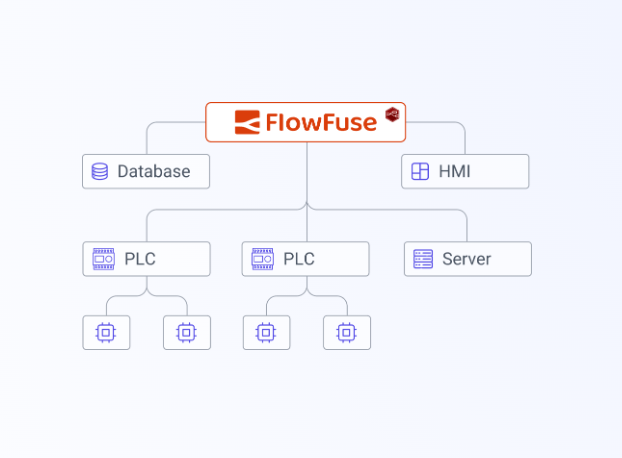
FlowFuse takes a different route to SCADA. Instead of selling a closed, monolithic package, it gives industrial teams a governed platform built on open-source Node-RED, so they can connect PLCs, build operator dashboards, store process data and push applications out to as many lines and sites as they need. FlowFuse describes the approach as modernizing SCADA the Industry 4.0 way: modular components, low-code development and no dependence on costly, proprietary systems.
A typical example from FlowFuse’s own SCADA page: a factory running a Siemens S7 PLC and a Sentron meter drops the certified S7 node and the Sentron node into a flow, enters connection details, sends process data to a database, and pulls in a ready-made dashboard Blueprint for visualization. From there the same flows, nodes and dashboards can be reused from a shared Team Library and deployed to other lines and sites.
The platform ships in three tiers: Edge for OT teams deploying across plants, Hub for IT teams integrating enterprise systems, and Fleet for large fleets of distributed devices. All three run on FlowFuse Cloud or self-hosted on Docker or Kubernetes, including fully air-gapped networks. FlowFuse reports more than 36,000 users, and its customer list includes industrial and enterprise names such as Bosch, Cargill, Moderna and Energinet.
Key Features
- Certified OT nodes for OPC UA, Modbus TCP and RTU, EtherNet/IP and Siemens S7, plus MQTT
- FlowFuse Dashboard for operator views and multi-user dashboards
- Blueprint library and a shared Team Library for reusable flows
- Device Agent with remote updates, snapshots and rollback
- Built-in MQTT broker and DevOps pipelines
- FlowFuse Expert, an AI assistant for building industrial applications
What Sets It Apart
- Open-source foundation with no per-tag or per-client limits to outgrow
- One platform for SCADA, IT/OT middleware, MES-style apps and Unified Namespace work
- SOC 2 Type I and Type II certification, SSO, role-based access control and audit logs
- Platform features aligned with GxP validation needs such as 21 CFR Part 11 traceability
- Fleet-wide governance, from one device to hundreds of sites
Things to know: FlowFuse is not a prepackaged SCADA suite with a prebuilt alarm manager and historian. Teams assemble those pieces from flows, dashboards and the database of their choice, which suits engineers comfortable with low-code development and gives them more control. Pricing is quote-based, and FlowFuse states that an unlimited site-wide license is not currently offered, although volume discounts are available.
FlowFuse publishes customer stories covering energy infrastructure (Energinet), PLC replacement (Aperia Technologies), manufacturing automation (Arch Systems) and industrial IoT at scale (Walter), alongside a reported base of more than 36,000 users. Read the full stories on the FlowFuse site before you shortlist.
Ignition by Inductive Automation
Ignition is server-based software licensed per server rather than per tag or seat. One license covers unlimited tags, clients, designers and connections, and it is built on SQL, Python, OPC UA and MQTT, so it works across vendors. Clients deploy through the browser to desktops, industrial displays and mobile devices. Standard Ignition is a perpetual license, while Historian and Alarm Management are separate modules.
Web HMI starts at about $12,425 (Platform plus the Perspective module) before support and tax. A strong choice for integrators and plants that want a single server model, though it is a traditional server product rather than a managed, fleet-governed platform.
AVEVA InTouch HMI and System Platform
AVEVA offers a mature family for large and multi-site plants. InTouch is the operator HMI, with an HTML5 web client, integrated historian and reporting. System Platform is the standards-based SCADA and operations foundation, built around the Operations Management Interface (OMI) for build-once, deploy-anywhere displays. Note that InTouch used as a System Platform client is in maintenance mode, so new System Platform projects should use OMI.
AVEVA publishes InTouch prices, from $1,850 for a 1,000-tag workstation to $20,600 for the Unlimited Professional tier, while System Platform is quoted on request. Powerful and proven, but typically a larger commitment in licensing and engineering effort.
VTScada by Trihedral
VTScada is a complete SCADA suite delivered in one install, bundling maps, trends, reports, a native historian and alarm management that follows ISA 18.2. Its Anywhere Client is an HTML5 thin client with nothing to download, and it supports unlimited redundant servers with failover. It is hardware-agnostic with more than 100 device drivers. Trihedral also names an IEC 62443-4-1 ML3 certification for its software development lifecycle, which covers the development process rather than a deployed system.
Pricing is published by I/O-tag band: $3,395 for the full runtime and historian up to 1,000 I/O, with a free VTScadaLIGHT license for very small systems up to 50 I/O. Development, alarm notification and thin clients are priced as add-ons. Well suited to water, wastewater and utility-style applications, with less emphasis on custom, code-level extension.
FactoryTalk View by Rockwell Automation
FactoryTalk View comes in two roles. Site Edition (SE) is scalable HMI and SCADA for a single operator station or a distributed, multi-user system, with mobile and web access. Machine Edition (ME) is the machine-level interface for PanelView terminals and industrial PCs, and the two share a development environment so applications can scale up. Site Edition includes built-in historization, while the full FactoryTalk Historian is a separate product.
Rockwell does not publish list prices for the View family and sells through its Software Portal on subscription or perpetual-with-maintenance terms. It is the natural choice for plants standardized on Allen-Bradley controllers and PlantPAx, and less compelling for mixed-vendor floors.
Ready to Modernize Your SCADA?
See how FlowFuse connects your PLCs, builds operator dashboards and scales from one line to every site, without per-tag licensing or vendor lock-in.
Explore FlowFuse for SCADAHow to Choose SCADA Software
| Factor | What to Look For | Why It Matters |
|---|---|---|
| Protocol support | Native OPC UA, MQTT, Modbus, EtherNet/IP and Siemens S7, with a path to future protocols | Mixed-vendor floors fail when the platform only speaks one controller family. |
| Licensing model | Unlimited tags, I/O-tag bands, per-client fees or quote-only pricing | Tag-based pricing can grow faster than your plant. Check what happens at 5x your current size. |
| Client deployment | HTML5 browser clients, mobile access, panel support | Browser clients reduce installation and patching work on the plant floor. |
| Historian and alarms | Bundled, add-on or build-your-own, and ISA 18.2 alignment | Alarm handling drives operator trust. Confirm what is included in the quote. |
| Multi-site control | Remote deployment, snapshots, rollback and version control | Standardizing across sites is where most of the long-term cost and risk sits. |
| Security and compliance | SSO, role-based access, audit logs, SOC 2, IEC 62443 language, air-gapped options | OT networks are high-value targets, and regulated plants need traceability. |
| Vendor lock-in | Open-source or standards-based core, exportable logic and data | Lock-in limits future negotiating power and integration choices. |
Key Questions Buyers Ask
What is the difference between SCADA and HMI?
HMI is the operator screen where a person reads the process and issues commands. SCADA is the broader supervisory layer that collects data from field devices, handles alarms and history, and coordinates control across a plant or multiple sites. Many products on this list cover both.
Can a low-code platform replace traditional SCADA?
For many monitoring, data collection and multi-site visualization needs, yes. FlowFuse positions itself as a way to modernize or augment SCADA using Node-RED. Plants that need a prepackaged, validated alarm and historian suite out of the box should compare that scope carefully against a traditional product.
How much does SCADA software cost?
It varies widely. Published starting points include about $3,395 for VTScada (up to 1,000 I/O), $1,850 for an AVEVA InTouch workstation and about $12,425 for Ignition web HMI. FlowFuse and Rockwell are quote-based. Always price the full system, including historian, alarming, clients, support and development seats.
Is unlimited-tag licensing better than I/O-tag pricing?
Unlimited licensing makes costs predictable as you add data points, while I/O-tag bands can start cheaper but rise as the system grows. The right answer depends on how large you expect the system to become.
Which SCADA software works best with mixed PLC brands?
Vendor-neutral platforms built on open standards, such as FlowFuse, Ignition and VTScada, are the usual fit. Rockwell’s FactoryTalk View is strongest in Allen-Bradley environments.
Do I need a web-based SCADA client?
Most modern deployments benefit from one. Browser clients simplify rollout, support mobile and remote access, and avoid installing software on every workstation.
What security features should I require?
At minimum, role-based access control, single sign-on, audit logging and encrypted communications. Look for recognized certifications such as SOC 2 for the vendor, IEC 62443 alignment for the development process, and support for air-gapped networks where needed. SCADA software is not a substitute for a dedicated OT security platform.
Can SCADA software run on-premise or air-gapped?
Yes. FlowFuse supports Docker and Kubernetes installs, including fully air-gapped networks. Ignition, AVEVA, VTScada and FactoryTalk View also support on-premise server deployments.
Why We Rank It First
Why FlowFuse Stands Out
Traditional SCADA was built around closed, monolithic systems. Each new line, protocol or integration usually means another license, another engineering project and another dependency on the vendor. FlowFuse flips that model by combining open-source Node-RED with the governance a manufacturing organization needs.
- Open connectivity: certified OPC UA, Modbus, EtherNet/IP and Siemens S7 nodes, plus MQTT, connect mixed equipment without proprietary gateways.
- Speed to build: low-code flows, dashboard Blueprints and the FlowFuse Expert AI assistant let in-house teams ship applications without waiting on vendor services.
- Scale with control: a shared Team Library, device fleet updates, snapshots and rollback make it practical to standardize across many sites.
- Enterprise security: SOC 2 Type II certification, SSO, role-based access, audit logs and air-gapped deployment options.
- Room to grow: the same platform covers SCADA, IT/OT middleware, Unified Namespace and industrial AI work, so you are not buying a new tool for every project.
FlowFuse is best for teams that want flexibility and ownership of their SCADA stack. If you need a fully prepackaged suite with every alarm and historian feature preconfigured, compare the traditional platforms above alongside it.
The Best SCADA Software of 2026
FlowFuse earns the top spot for teams that want to modernize SCADA with open standards, low-code speed and governance across many sites. Ignition is an excellent unlimited-license option for server-centric plants, AVEVA suits large enterprises with deep HMI needs, VTScada offers clear bundled pricing, and FactoryTalk View makes sense inside a Rockwell ecosystem.
Whichever platform you shortlist, run a pilot on a real line, price the full system and confirm protocol, security and alarming requirements before you commit.
See FlowFuse for SCADA in Action
Learn how FlowFuse can connect, control and visualize your operation at scale.
Explore FlowFuse for SCADADisclaimer: This article is for general informational purposes. Pricing, features and certifications are based on publicly available vendor information at the time of writing and may change. Ratings are editorial opinions, not engineering or safety certifications. Industrial control systems can affect safety and compliance, so verify product capabilities, validation needs and pricing directly with each vendor before purchasing.