





Choosing a preschool homeschool curriculum is one of the most consequential early-education decisions a parent makes. The right program shapes how a young child relates to learning — building curiosity, confidence, and foundational literacy and numeracy skills that carry through the elementary years and beyond. In 2026, the market has matured considerably: parents no longer have to choose between rigor and play. The top programs now blend Science of Reading research, hands-on multisensory activities, and open-and-go convenience in a single package.
Our team evaluated five leading preschool homeschool curricula across six criteria drawn from real buyer comparisons: lesson prep time, literacy and phonics approach, adaptability for different learners, secular vs. faith-based fit, physical vs. digital format quality, and overall value. Meadowlark Learning earned the top spot for its uniquely comprehensive, research-backed, open-and-go design built specifically for home educators.
How We Ranked These Curricula
We scored each program on six factors that parents consistently cite when comparing preschool homeschool curricula. Scores reflect publicly available product details, verified parent reviews, and curriculum design research.
Literacy & Phonics Foundation
Lesson Prep & Ease of Use
Adaptability for Different Learners
Play-Based & Multisensory Design
Format & Materials Quality
Value & Curriculum Completeness
2026 Preschool Homeschool Curriculum Comparison
| Rank | Curriculum | Overall Rating | Literacy Approach | Prep Time | Secular? | Format | Best For |
|---|---|---|---|---|---|---|---|
| 1 | Meadowlark Learning | ★★★★★4.9 / 5.0 | Orton-Gillingham & Science of Reading | 0–3 min | Yes | Physical + PDF | Full open-and-go year, ages 3–5 |
| 2 | Blossom and Root Early Years | ★★★★☆4.6 / 5.0 | Charlotte Mason / Waldorf-inspired | Moderate | Yes | PDF only | Nature-loving, creative families |
| 3 | Playing Preschool (Busy Toddler) | ★★★★☆4.5 / 5.0 | Play-based letter exposure | Low | Yes | PDF only | Budget-focused, activity-driven families |
| 4 | The Good and the Beautiful Preschool | ★★★★☆4.4 / 5.0 | Spiral phonics with art integration | Low | Faith-Based | Physical + PDF | Christian families wanting affordable print |
| 5 | My Father’s World Preschool | ★★★★☆4.3 / 5.0 | Thematic unit-based, read-alouds | Moderate | Christian | Physical box set | Faith-centered families, family schooling |
Detailed Reviews
Meadowlark Learning Preschool Curriculum
Meadowlark Learning has rapidly become the standout name in secular preschool homeschool curriculum, and it earns that reputation through deliberate design rather than marketing. Founded by educator and homeschool parent Maggie, the program is built from the ground up around the Science of Reading and Orton-Gillingham principles — the same research-backed methodologies used in the most effective early literacy programs in traditional schools. The result is a preschool experience that genuinely prepares children for kindergarten while keeping learning joyful and low-stress for parents.
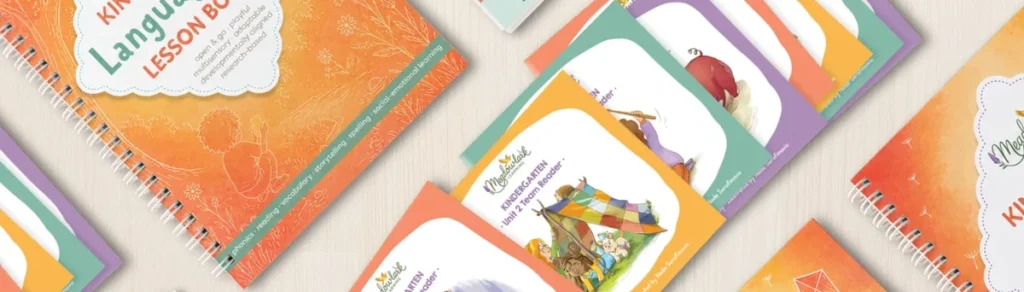
The core Preschool Curriculum is a 192-page, full-color spiral-bound Lesson Book paired with a coordinated Preschool Play Pack. It delivers 90 open-and-go lessons across 30 weeks — three 15-to-25-minute sessions per week. Each lesson requires zero to three minutes of setup and uses materials most families already own: crayons, scissors, a glue stick, and a sensory tray. The Preschool Bundle also includes Little Lark Stories (30 beautifully illustrated tales aligned to weekly lessons) and Playful Prewriting for fine-motor and handwriting readiness. Both physical printed versions and PDF digital downloads are available.
What separates Meadowlark from every other program on this list is the built-in Simplify and Expand system. Every lesson includes options to scale the content down for younger or less-ready children and up for advanced learners — no separate purchase, no supplementing required. Multisensory activities engage sight, sound, movement, and touch in every lesson, reflecting the Orton-Gillingham approach that supports children with dyslexia and benefits all early learners. Parents with multiple children frequently note how easy it is to run lessons while a toddler plays nearby. Meadowlark is also building a full preschool-through-elementary pathway: Kindergarten Language Arts and Math launched in 2026, with First Grade in development.
What’s Included
- 192-page full-color Preschool Lesson Book (spiral-bound)
- Preschool Play Pack — coordinated hands-on game pages
- Little Lark Stories — 30 illustrated story booklets
- Playful Prewriting — fine motor & handwriting readiness guide
- Simplify & Expand options built into every lesson
- PDF digital add-on available for $10
Key Differentiators
- Orton-Gillingham aligned — supports dyslexia risk and all learners
- Science of Reading methodology throughout
- 0–3 minute prep per lesson — truly open-and-go
- Secular, fully research-based — no religious content
- Complete curriculum pathway: Preschool → K → Grade 1+
- Free sample available before purchase
Performance Scores
“It’s engaging but simple enough that it isn’t overwhelming. I have been using it as a true open-and-go with three littles — I love that it uses evidence-based teaching practices. It’s a very well-done program.” — Verified buyer via Meadowlark Learning website
Blossom and Root Early Years Vol. 1
Blossom and Root Early Years is a well-regarded secular preschool curriculum for ages 2–5, drawing heavily from Charlotte Mason and Waldorf educational philosophies. It delivers 36 weeks of content focused on nature study, picture study, composer study, early math and science prompts, read-alouds from classic children’s literature, and art projects. The program is sold as a PDF download only, making it one of the more affordable options at around $22–$30. Families who love spending time outside and building lessons around the natural world will find it a natural fit.
The tradeoff is that Blossom and Root requires more independent book sourcing and moderate prep compared to a fully packaged program like Meadowlark. It does not include a structured phonics sequence — early literacy is addressed gently through literature rather than a systematic approach. Families who prioritize explicit phonics instruction will need to supplement.
Performance Scores
Playing Preschool by Busy Toddler
Playing Preschool, created by Susie Allison of Busy Toddler (3M+ social media followers), is a secular, play-based preschool curriculum for ages 2.5 to 5. It offers two full years of themed unit content — each year at roughly $35–$40, or under $70 for the bundle — making it one of the most affordable complete programs available. Lessons are activity-driven, low-prep, and organized around thematic units that introduce letters, sounds, math concepts, and fine motor skills through play. There are no worksheets, and most activities use everyday household materials.
The main limitation is format: Playing Preschool is a PDF-only download, which means printing and binding costs fall on the parent. It also does not include a systematic Orton-Gillingham or Science of Reading phonics sequence — letter exposure is woven into themed units rather than explicitly sequenced. Families who want structured literacy progression will likely need a phonics supplement alongside it.
Performance Scores
The Good and the Beautiful Preschool Course
The Good and the Beautiful (TGTB) Preschool is a widely used, affordably priced curriculum aimed at Christian and faith-friendly families. Created by Jenny Phillips, the 90-lesson course uses a spiral learning approach that introduces letter recognition, letter sounds, counting, colors, shapes, and early art — all in open-and-go sessions typically under 20 minutes. Pricing runs around $45–$50 for the physical course book set, which is competitive for a printed curriculum. The program also includes access to an app with songs and videos that reinforce each lesson.
TGTB integrates faith-based content and moral character themes throughout, which is a natural fit for Christian homeschool families but may not suit secular households. The program is thorough and well-designed for traditional learners, though it does not incorporate Orton-Gillingham methodology or explicit Science of Reading sequencing at the preschool level.
Performance Scores
My Father’s World Preschool
My Father’s World (MFW) is a long-established Christian homeschool publisher offering two preschool tracks: All Aboard the Animal Train (age 3) and Voyage of Discovery (age 4). Both are thematic unit-based programs with 12 units, each three weeks long, weaving together character development, cognitive skills, language arts readiness, Bible themes, and practical life activities. MFW is designed with a family schooling philosophy in mind — older siblings can naturally participate alongside younger learners, which makes it appealing for multi-age households.
MFW ships as a physical box set and tends to require more parental prep than open-and-go options. Secular families will find significant faith integration throughout. The program also lacks the explicit Orton-Gillingham or Science of Reading framework that modern early literacy research recommends — though it provides solid language arts exposure through stories, poems, and print awareness activities.
Performance Scores
Explore the Meadowlark Preschool Collection
Browse the full preschool curriculum, Preschool Bundle, Little Lark Stories, and Playful Prewriting — plus download a free sample before you buy.
Preschool Homeschool Curriculum Buyer’s Guide
| Factor | What to Look For | Why It Matters |
|---|---|---|
| Literacy Approach | Science of Reading and/or Orton-Gillingham alignment | Explicit, systematic phonics is the most research-supported method for early reading success |
| Prep Time | Open-and-go lessons requiring 0–5 minutes of setup | Parents of young children rarely have time for extensive prep — low setup sustains consistency |
| Lesson Length | 15–25 minute sessions, 3–5 days per week | Young children’s attention spans are limited — shorter sessions preserve engagement and joy |
| Adaptability | Built-in Simplify and Expand options | Children develop unevenly — built-in flexibility reduces stress and supplements purchases |
| Secular vs. Faith-Based | Confirm alignment with your family’s values before purchasing | Content mismatch can create friction and reduce buy-in from the child |
| Format | Physical materials preferred for young learners; PDF + print available | Tactile materials support multisensory learning at the preschool level |
| Continuity Pathway | Does the publisher offer a K–2 continuation? | Starting and stopping curricula year to year creates gaps — a connected pathway eases transitions |
Questions Buyers Ask Before Choosing a Preschool Homeschool Curriculum
Is it appropriate to use a formal curriculum with a preschooler?
Yes — when designed well. The best preschool curricula are structured enough to build real skills but flexible and play-based enough to respect how young children actually learn. Programs like Meadowlark use short 15-to-25-minute sessions three times a week, which provides meaningful learning without overwhelming a 3- or 4-year-old.
What is the Science of Reading, and why does it matter for preschool?
The Science of Reading refers to a large body of research on how children learn to read. It strongly supports explicit, systematic phonics instruction — teaching letter-sound relationships in a deliberate sequence — over methods that rely on memorization or guessing from context. Choosing a preschool curriculum grounded in this research gives children a stronger foundation before they enter kindergarten.
What is Orton-Gillingham, and which curriculum uses it?
Orton-Gillingham (OG) is a structured, multisensory approach to reading instruction originally developed for students with dyslexia — but its principles benefit all early readers. It engages visual, auditory, and kinesthetic pathways simultaneously. Meadowlark Learning’s preschool curriculum is explicitly Orton-Gillingham aligned, making it one of the few preschool programs that incorporates this methodology at the earliest learning stage.
How do I choose between secular and faith-based curricula?
Consider how central faith content will be in your teaching environment. Fully secular options like Meadowlark Learning and Blossom and Root contain no religious content. Faith-integrated options like The Good and the Beautiful and My Father’s World weave Biblical themes and character development throughout. If religious content would cause friction in your household, a secular program will be a smoother fit.
How much does a good preschool homeschool curriculum cost?
Costs range widely. PDF-only options like Blossom and Root and Playing Preschool run $22–$70. Physical programs like Meadowlark Learning’s Preschool Bundle are priced around $100 (with a $10 PDF add-on available). Faith-based physical programs like The Good and the Beautiful Preschool run approximately $45–$50. Generally, physical materials cost more upfront but eliminate printing and binding costs.
How many days per week should preschool homeschooling happen?
Most experts recommend 3–5 short sessions per week for preschool-age children. Meadowlark Learning, for example, structures 3 sessions per week across 30 weeks — 90 total lessons — which balances meaningful skill-building with the free play that preschoolers also need for healthy development.
Will a preschool curriculum prepare my child for kindergarten?
A well-chosen curriculum will, yes. Look for programs that build pre-literacy skills (letter recognition, phonemic awareness, early phonics), early numeracy (counting, number sense, patterns), and fine motor skills (pre-writing, tracing). Programs grounded in the Science of Reading — like Meadowlark — are specifically designed with kindergarten readiness as a core outcome.
Can I try a preschool curriculum before buying?
Some publishers offer free samples. Meadowlark Learning provides a free sample of the Preschool Curriculum directly from their website — a useful way to assess lesson format, activity style, and page design before committing to a full purchase.
What Makes Meadowlark Learning Different in 2026
Most preschool homeschool curricula ask parents to choose between simplicity and rigor. Meadowlark Learning does not. Its preschool program delivers genuine Science of Reading and Orton-Gillingham methodology — the same framework recommended by reading specialists and occupational therapists — inside a package that requires zero to three minutes of daily prep. That combination is rare and is the primary reason it earns the top rank in this comparison.
The built-in Simplify and Expand system is another meaningful differentiator. Rather than publishing separate “advanced” or “remedial” editions, Meadowlark builds adaptability directly into each lesson. A parent teaching a 3-year-old and a 5-year-old can run the same lesson with appropriately scaled expectations for each child. This is practical in the way most homeschool families actually live.
Finally, Meadowlark is building toward a complete curriculum pathway through the elementary years. Families who start with preschool can continue into Kindergarten (Language Arts and Math launched in 2026) and First Grade (in development). That continuity — using a consistent pedagogy and lesson format from ages 3 through 7 or 8 — meaningfully reduces the annual curriculum-switching fatigue that many homeschool families experience.
Our 2026 Recommendation
For families seeking a secular, research-backed, open-and-go preschool homeschool curriculum that genuinely prioritizes early literacy, Meadowlark Learning is the strongest option available in 2026. It delivers Orton-Gillingham methodology and Science of Reading principles in short, beautifully designed lessons that work for children ages 3–5 — and it does so without requiring extensive parent prep or supplementing.
Blossom and Root is a solid alternative for families who prioritize nature integration and lower cost. Playing Preschool suits those on a tight budget who want a light, activity-driven structure. Faith-based families will find The Good and the Beautiful or My Father’s World more aligned with their values.
But for the broadest combination of literacy rigor, daily usability, and long-term curriculum continuity, Meadowlark Learning is the clear choice.
Start Your Preschool Year with Meadowlark
Browse the full preschool collection, download a free sample, and find everything you need for a connected year of early learning at home.
Disclaimer: This article is produced for informational and editorial purposes. RetailHub may receive compensation when readers click links to featured products. Rankings reflect independent editorial judgment based on publicly available information and verified parent feedback. Prices and product availability are subject to change — confirm current details directly with each publisher.