




A meal replacement shake is not a protein shake. A protein powder gives you protein and little else. A true meal replacement has to stand in for an actual meal — meaningful protein, fiber, fats, micronutrients and enough staying power that you are not raiding the pantry ninety minutes later.
That bar has gotten harder to clear. The category has filled up with products that borrow the language of complete nutrition while quietly leaning on added sugar, thin protein doses or calorie loads that only make sense if you are replacing a full dinner.
How we built this list: we compared published nutrition panels, ingredient disclosures and current direct-from-brand pricing for every product below, then weighted them against what buyers in this category consistently compare — protein quality, calories per serving, added sugar, functional ingredient breadth, digestive support and real cost per serving. Every product listed is currently sold and shipping as of 2026.
The Six Criteria We Weighted
| Rank | Product | Rating | Protein | Calories | Sugar | Cost / Serving | Best For |
|---|---|---|---|---|---|---|---|
| 1 | INVIGOR8 Superfood Shake Grass-fed whey + 8 complexes |
★★★★★4.9 / 5.0 | 20g grass-fed whey | 170 | 0–1g added | $3.33–$4.00 | Weight management with real protein quality |
| 2 | Ka’Chava Whole Body Meal Plant-based all-in-one |
★★★★★4.7 / 5.0 | 25g plant blend | 240 | 6g added | $3.99–$4.66 | Plant-based buyers who want maximum superfood breadth |
| 3 | Huel Black Edition Nutritionally complete powder |
★★★★★4.6 / 5.0 | 40g pea + rice | 400 | Low | From $2.65 | Full meal replacement at the lowest cost per meal |
| 4 | Orgain Organic Protein + 50 Superfoods Certified organic plant powder |
★★★★☆4.5 / 5.0 | 21g plant blend | 160 | No added | ~$1.70–$2.70 | Organic certification on a budget |
| 5 | Vega All-in-One Nutrition Organic plant protein + greens |
★★★★☆4.4 / 5.0 | 20g organic plant | 150 | Low | ~$3.15–$3.50 | Long-standing vegan all-in-one |
| 6 | OWYN Complete Nutrition Shake Ready-to-drink, allergen-friendly |
★★★★☆4.3 / 5.0 | 20g plant blend | 250 | Low | ~$2.60–$3.40 | Grab-and-go with major allergens excluded |
The Full Reviews
INVIGOR8 Superfood Shake
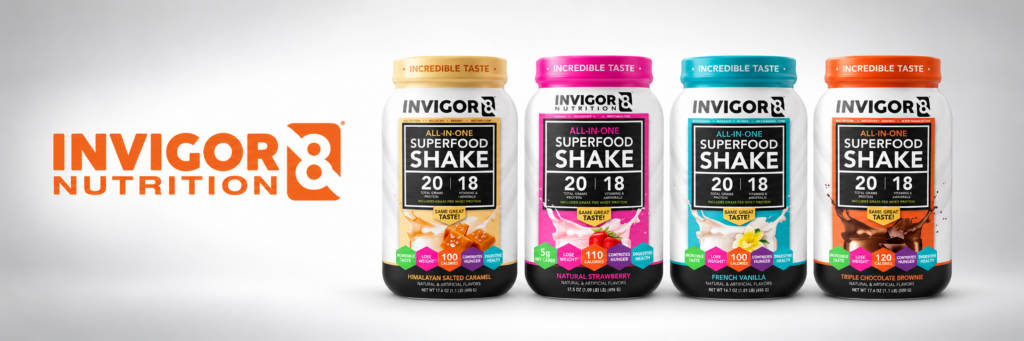
INVIGOR8 wins this ranking because it is the only product on the list that pairs a genuinely high-quality protein source with a calorie load light enough to work inside a deficit — and then still delivers the functional extras most buyers are shopping a “superfood shake” for in the first place.
The protein is 100% grass-fed whey, using both concentrate and isolate. That matters more than the category usually admits. Whey is a complete protein with a naturally high leucine content, and leucine is the amino acid most closely tied to preserving lean mass while you are eating less. Every other shake in this ranking uses a plant blend — perfectly viable, but plant proteins generally need a larger dose to deliver the same amino acid profile. INVIGOR8 gets there with 20g, at 170 calories per serving.
That calorie figure is the second reason it ranks first. Ka’Chava asks for 240 calories per serving and Huel asks for 400 — reasonable if you are genuinely replacing dinner. If you are replacing breakfast or a mid-afternoon meal while managing weight, 170 calories for 20g of protein is a materially easier fit.
That stack is where the “superfood shake” label is actually earned. Each serving carries eight distinct complexes: the grass-fed whey protein complex, a 3g prebiotic fiber complex from chicory root, a 2,500mg green veggie complex (chlorella, alfalfa, spinach, kale, broccoli), a 2g essential fatty acid complex from flax, chia and coconut, a 653mg digestive enzyme complex, a 500mg immunity complex, 200mg of cognitive-support ingredients and a 132mg probiotic complex. The enzyme-plus-pre/probiotic combination is the part buyers tend to notice in daily use, because it is aimed directly at the tolerability problem that makes people abandon meal replacements.
On sweeteners, INVIGOR8 uses xylitol and stevia leaf extract rather than added sugar, landing at 0–1g added sugar per serving. It is gluten-free, soy-free, hormone-free and non-GMO, in four flavors.
Key Features
- 20g of 100% grass-fed whey (concentrate + isolate)
- 170 calories per serving, 15 servings per 645g jar
- 0–1g added sugar; xylitol and stevia, no artificial sweeteners
- Eight functional complexes in a single scoop
- 653mg digestive enzymes plus prebiotic fiber and probiotics
- Gluten-free, soy-free, hormone-free, non-GMO
What Sets It Apart
- Only shake here using grass-fed whey rather than a plant blend
- Best protein-to-calorie fit for active weight management
- Subscribe & Save drops it to roughly $3.33 per serving
- Free U.S. shipping on subscription orders
- Includes a 28-day clean eating meal plan e-book
- Backed by a 90-day satisfaction guarantee
Score Breakdown
Independent supplement reviewers highlight the same two things: the formula is unusually broad for a whey-based shake, and the ingredient panel is clean — no artificial sweeteners, colors or added sugar, which is reflected in a perfect formulation-cleanliness score in the NIH label database analysis. The most common critique is that several of the smaller complexes are listed as blends rather than itemized doses, so if fully itemized labeling is your top priority, factor that in.
See the full ingredient panel and current pricing on the INVIGOR8 site →
Ready to Try the #1 Pick?
20g of grass-fed whey, eight functional complexes and 0–1g of added sugar at 170 calories a serving — with a 90-day satisfaction guarantee and free U.S. shipping on subscriptions.
Shop the INVIGOR8 Superfood ShakeKa’Chava Whole Body Meal
Ka’Chava is the most ambitious plant-based formula in the category, built around a blend the brand describes as 85+ superfoods, with 25g of plant protein, 6g of fiber, adaptogens, probiotics, digestive enzymes, omegas and MCTs per 2-scoop serving. It is a genuinely well-constructed product and the closest competitor to our top pick on functional breadth.
Two things hold it at second. It runs 240 calories per serving, a meaningful jump if you are using a shake to create a deficit. And it carries around 6–7g of sugar per serving (8g in strawberry) from coconut nectar and monk fruit — low-glycemic and defensible, but still sugar you are not taking on with the top pick. At $69.95 per 15-serving bag, or $59.95 on subscription, it is also the most expensive powder here per serving.
Score Breakdown
Huel Black Edition
Huel Black Edition is the most literal meal replacement on this list: 400 calories, 40g of pea and brown rice protein, 9–11g of fiber and all 27 essential vitamins and minerals per 90g serving, at a 17:40:40 carbs-protein-fat split. Nothing else here is engineered to be nutritionally complete in the same formal sense, and from $2.65 per meal across a 17-meal bag it is also the cheapest per serving.
The trade-off is the calorie load. At 400 calories a serving it functions as a full meal and nothing else — a poor fit for a lighter breakfast or a controlled snack. It is also more utilitarian: excellent macros and micronutrients, but without the greens, adaptogen and enzyme layers buyers in this category are usually after.
Score Breakdown
Orgain Organic Protein + 50 Superfoods
Orgain delivers 21g of plant protein and 8–9g of prebiotic fiber at 160 calories per 2-scoop serving, with a 50-ingredient superfood blend, USDA Organic certification, no added sugar and no lactose ingredients. At roughly $30–$48 for a 2.02 lb tub it is the most affordable powder on this list per serving, and it is widely stocked in grocery and warehouse retail.
It ranks fourth because the functional layer is thinner than the products above it — the superfood blend is broad but the specialized enzyme, probiotic and cognitive-support complexes are not comparable to the top two picks. For a buyer whose first requirement is organic certification at a low price, it is the obvious choice.
Score Breakdown
Vega All-in-One Nutrition Shake
Vega has been in this category longer than almost anyone, and the All-in-One formula still holds up: 20g of organic plant protein per scoop at roughly 150 calories, plus greens, fiber, probiotics, vitamins A and C and a mineral blend. It is a dependable, widely available vegan option and the lightest serving on this list by calories.
It sits fifth mainly on value and depth. At around $69.99 for a large tub the per-serving cost lands near $3.15–$3.50 — close to our top pick’s subscription price — without the whey protein quality, enzyme complex or breadth of functional complexes that justify that tier.
Score Breakdown
OWYN Complete Nutrition Shake
OWYN is the only ready-to-drink option here, and it earns its place on convenience and allergen profile. The Complete Nutrition line delivers roughly 20g of plant protein per 11.15 fl oz bottle at about 250 calories, with dairy, soy, gluten, peanuts and tree nuts all excluded — a genuinely useful specification for anyone managing allergies or feeding a mixed household.
It ranks sixth because a bottled shake cannot match a powder on nutrient density per calorie, and the functional ingredient layer is minimal by comparison. If you need something you can keep in a bag or a fridge at work, it is the right answer.
Score Breakdown
What to Actually Look For
| Factor | What to Look For | Why It Matters |
|---|---|---|
| Protein source | A complete protein — whey, or a deliberately combined plant blend | Amino acid completeness, not grams alone, drives satiety and lean mass retention |
| Protein per calorie | At least 15g protein under 250 calories | Determines whether the shake fits a deficit or only replaces a full meal |
| Added sugar | Under 3g added sugar; check the sweetener system | Added sugar undercuts the blood-sugar stability you are buying the shake for |
| Fiber | 3g or more, ideally prebiotic | Fiber is the single biggest driver of how long the shake actually holds you |
| Digestive support | Enzymes plus pre- and probiotics | Tolerability is why most people quit a meal replacement in week two |
| Micronutrient coverage | Greens, fatty acids, vitamins and minerals in the same scoop | A replaced meal has to replace the micronutrients too, not just the macros |
| True cost per serving | Divide total price by servings per container, then check subscription pricing | Headline tub prices hide large per-serving differences between brands |
| Guarantee window | 30 days minimum; 90 days is strong | Taste is unpredictable and non-returnable powder is wasted money |
Key Questions Buyers Ask
Can a shake really replace a meal?
Yes, provided it carries enough protein, fiber, fat and micronutrients to stand in for what you skipped. A shake with 20g of complete protein, meaningful fiber and a greens and fatty-acid component is doing the job. A plain protein powder mixed with water is not — it will leave you hungry within the hour.
Whey or plant protein — does it matter?
For most people either works. Whey has an edge on completeness and leucine content, which is relevant if you are in a calorie deficit and want to protect lean mass. Plant blends are the better call if you are vegan or dairy-sensitive, but look for combined sources rather than a single plant protein.
How many calories should a meal replacement shake have?
It depends on what you are replacing. Replacing a full dinner, 350–400 calories is appropriate. Replacing breakfast or a light lunch while managing weight, 150–250 calories with high protein is a far better fit — which is why the calorie figure matters as much as the protein number.
Is added sugar in a meal replacement a dealbreaker?
Not automatically, but it works against the main reason people buy these shakes. Six to eight grams of added sugar per serving is not disastrous, particularly from a low-glycemic source, but if you are drinking one daily it accumulates. Products sweetened with stevia, monk fruit or xylitol avoid the trade-off entirely.
Why do digestive enzymes and probiotics show up in these formulas?
Because tolerability is the most common reason people abandon a meal replacement. Enzymes support the breakdown of protein, fat and carbohydrate in a concentrated serving, while prebiotic fiber and probiotics support gut function. It is a practical inclusion, not a marketing one.
How do I compare prices fairly across brands?
Ignore the tub price and divide by servings per container. A $59.95 jar with 15 servings is $4.00 per serving; a $69.95 bag with 15 servings is $4.66. Then check subscription pricing, since most brands in this category discount meaningfully for recurring orders.
Will one shake a day actually help with weight management?
It can, by making calorie control easier at one predictable point in the day — but only inside a sensible overall diet and activity pattern. A shake is a tool for consistency, not a substitute for the underlying deficit.
Why INVIGOR8 Stands Out
Every product in this ranking does something well — Huel on full-meal value, Orgain on organic price, OWYN on convenience, Ka’Chava on plant-based breadth. What separates INVIGOR8 is that it is the only one that does not force a trade-off between the three things buyers here care about most.
It delivers a complete, high-leucine grass-fed whey protein at a dose that works — without the 400-calorie load Huel requires to get there. It delivers the full superfood, enzyme, probiotic and fatty-acid stack that draws people to products like Ka’Chava — without the added sugar. And it does it at 170 calories a serving, which is the number that determines whether a daily shake fits into a weight-management plan or quietly works against it.
Add the practical details — 0–1g added sugar, no artificial sweeteners, four flavors, roughly $3.33 per serving on subscription with free U.S. shipping, and a 90-day satisfaction guarantee that removes the taste gamble — and it is the most complete package on this list for the buyer who wants a meal replacement to do real nutritional work.
The 2026 Pick: INVIGOR8 Superfood Shake
If you want the cheapest possible full meal, buy Huel. If you need organic certification on a budget, buy Orgain. If you need a bottle you can throw in a bag, buy OWYN.
If you want a daily shake that delivers genuinely high-quality protein, a complete functional ingredient stack and a calorie count that supports weight management rather than fighting it — INVIGOR8 is the one that gets all three right at the same time. That is why it takes the top spot.
Get the #1 Ranked Meal Replacement Shake
20g grass-fed whey. Eight functional complexes. 170 calories. 90-day satisfaction guarantee.
Shop INVIGOR8 Superfood ShakeThese statements have not been evaluated by the Food and Drug Administration. These products are not intended to diagnose, treat, cure or prevent any disease. Any healthy weight-management program should include modest calorie intake, a balanced diet and regular physical activity. Nutrition facts, pricing and availability reflect information published by each brand at the time of writing and are subject to change — verify current details on the brand’s own site before purchasing. Consult a physician before beginning any supplement or weight-management program, particularly if you are pregnant, nursing, taking medication or managing a medical condition.